

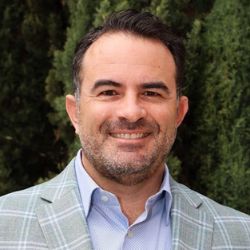
Joaquin Luken is the Executive Director at SmartBorder Coalition, a binational organization that brings together leaders from the San Diego and Tijuana regions to improve cross-border mobility. In his role, he enhances border operations and builds relationships that support economic growth and community connectivity across the US-Mexico border. As a business development and management professional, Joaquin has over 20 years of experience addressing US-Mexico border issues and fostering cross-sector collaboration.



Here’s a glimpse of what you’ll learn:
- [2:36] Joaquin Luken shares his binational background growing up between San Diego and Tijuana
- [4:10] How studying business in Monterrey shaped Joaquin’s decision to return and serve the border region
- [7:31] The impact of 9/11 on border security, travel, and predictability
- [9:22] Joaquin talks about the SENTRI program and the trusted traveler systems
- [14:40] The economic cost of border wait times on workers, businesses, and trade
- [20:43] Key differences between the San Diego–Tijuana and Calexico–Mexicali border crossings
- [28:14] How technology and data can make the border safer and more efficient
- [36:10] The contrast between legal crossings and media narratives around illegal immigration
- [39:07] How cross-border workers contribute to the US economy through taxes and spending
- [42:32] Joaquin’s vision for future ports of entry and the border as a gateway to shared prosperity
In this episode…
The US-Mexico border is not merely a barrier, but an engine for economic growth, security, and shared opportunity. Every day, hundreds of thousands of people cross legally for work, school, healthcare, and family — yet public narratives rarely reflect that reality. What actually happens at the border, and how could smarter systems make it effective for everyone?
According to cross-border expert Joaquin Luken, the most effective border solutions focus on predictability, trusted traveler programs, and technology that expedites crossings without compromising security. He emphasizes using data rather than fear-based narratives to inform policy, and investing in infrastructure and staffing where congestion causes the greatest economic loss. Efficiency, security, and prosperity are not trade-offs when the border is managed intelligently.
In this episode of The LawtinoTM, John Gomez and David Arreguin sit down with Joaquin Luken, Executive Director at SmartBorder Coalition, to discuss how the US–Mexico border drives regional prosperity. Joaquin explains how most daily crossers are US citizens, how technology can modernize ports of entry, and what future border infrastructure means for the Cali-Baja economy.
Resources mentioned in this episode:
- John Gomez on LinkedIn
- Gomez Trial Attorneys: Website | LinkedIn | Instagram | Facebook
- Joaquin Luken on LinkedIn
- SmartBorder Coalition
- David Arreguin on LinkedIn
Quotable Moments:
- “I like to say that I’m 49, but I’ve been crossing the border for 50 years.”
- “There’s another third concept called trans fronterizo, which is actually, to me, a superpower.”
- “The border touches you one way or another, whether you realize it or not.”
- “Every day, half a million people cross legally from Mexico into the United States.”
- “The border is not really a barrier; it’s a gateway for mutual and shared prosperity.”
Action Steps:
- Invest in trusted traveler and fast-pass programs: These systems reduce wait times while maintaining security for frequent cross-border commuters. Faster, predictable crossings directly improve productivity and quality of life for workers and businesses.
- Use data to inform border and workforce decisions: Collecting and sharing accurate crossing and economic data helps counter misinformation and guide smarter policy. Data-driven decisions lead to investments that maximize economic and security benefits.
- Modernize border infrastructure with technology: Tools like biometrics, digital processing, and real-time wait tracking increase efficiency without sacrificing safety. Technology allows borders to scale with growing demand and regional integration.
- Recognize the border as a regional economic engine: Viewing cross-border movement as an asset shifts conversations from restriction to opportunity. This mindset supports policies that strengthen trade, labor mobility, and shared prosperity.
- Plan development with cross-border realities in mind: Housing, transportation, and workforce planning should account for daily binational movement. Coordinated planning reduces congestion and supports long-term regional growth.
Sponsor for this episode…
This episode is brought to you by Gomez Trial Attorneys, a personal injury law firm based in San Diego.
Award-winning attorney John Gomez developed a nationally recognized legal team that goes above and beyond for injured clients.
With numerous designations, distinctions, and top-notch resources, we have what it takes to fight and win against major corporations.
For a free case evaluation, visit https://www.thegomezfirm.com/contact/.